

Introduction
The European packaging industry is undergoing one of its most significant transformations in decades. Driven by environmental pressure and new EU regulations, countries across Europe are moving toward more advanced waste management systems, higher recycling rates, and increased use of reusable packaging.
Portugal and Spain, in particular, are playing a key role in this transition, especially with the rollout of Deposit Return Schemes (DRS) that are set to reshape the beverage, food, and packaging industries across Southern Europe.
EU Packaging Regulation (PPWR): A Unified Framework for Circular Economy
The Packaging and Packaging Waste Regulation (PPWR) is the cornerstone of Europe’s new packaging strategy. It aims to create a unified system across all member states and accelerate the transition toward a circular economy.
The core objectives include:
- Ensuring all packaging is recyclable by 2030
- Increasing the use of recycled materials in production
- Reducing unnecessary and single-use packaging
- Expanding Deposit Return Systems across Europe
- Standardizing waste sorting and labeling across member states
This regulation represents a fundamental shift in how packaging is designed, used, and recovered across the European market.
Source: European Commission
Portugal: Strengthening Recycling Through Deposit Return Systems
Portugal is currently working to improve its recycling performance, particularly in plastic bottle collection, where it still falls behind EU targets. Challenges such as inefficient waste separation and low consumer participation have pushed the country to adopt structural reforms.
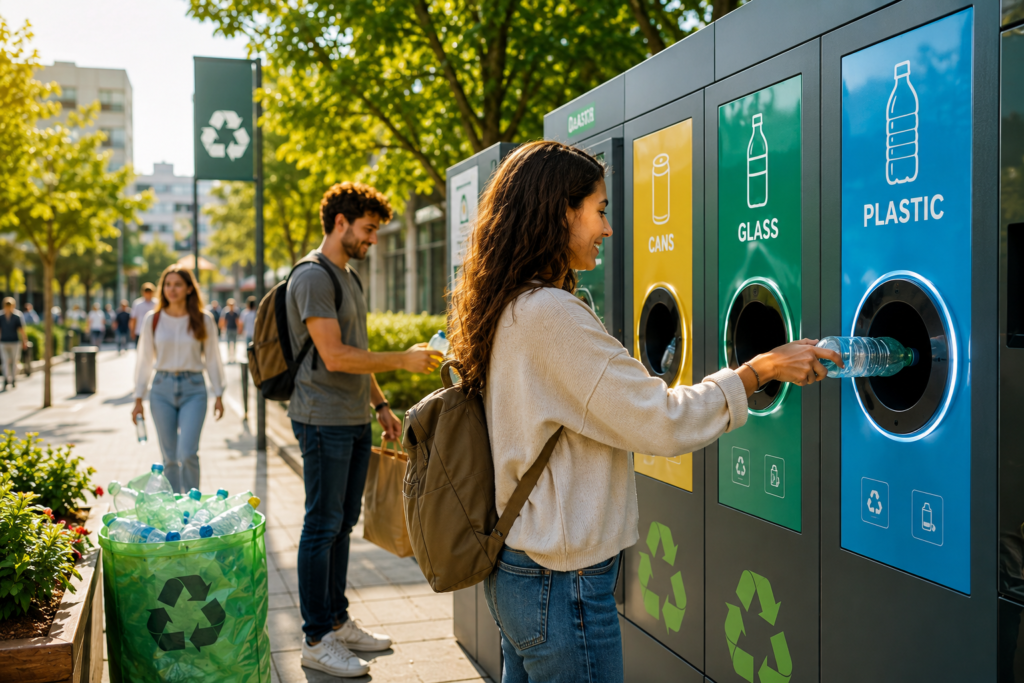
To address these issues, Portugal is introducing a Deposit Return Scheme (system) (DRS), where consumers pay a small deposit when purchasing beverages and receive it back when returning empty bottles or cans.
This system is designed to:
- Increase PET bottle collection rates
- Improve recycling quality for industrial reuse
- Reduce environmental leakage of plastic waste
Countries like Germany and Nordic nations have already proven the effectiveness of this model, achieving recycling rates above 90%.
Source: Euronews
Spain: Launching a Nationwide Bottle Deposit System in 2026
Spain is taking a more advanced step by confirming the implementation of a nationwide Deposit Return Scheme starting in November 2026.
Under this system:
- A refundable deposit will be added to beverage containers
- Consumers will get their money back when returning bottles or cans
- The system will cover plastic bottles and aluminium cans
- Retailers will be required to install return infrastructure
The main objective is to significantly increase collection rates and move closer to the EU’s 90% recycling target.
Source: Euro Weekly News
Aluminium Recycling in Europe: A Quality Challenge
Alongside plastic waste, aluminium recycling also presents a major challenge in Europe. Although aluminium is highly recyclable, the main issue lies in alloy contamination, which reduces the quality of recycled material.
As a result, a significant portion of recycled aluminium is downgraded and cannot be reused in high-value applications.
To solve this issue, Europe is investing in:
- Advanced sorting and separation technologies
- Digital material tracking systems
- High-value recycling processes
Source: ALCircle
Global Concern: Recycled Plastics in Food Packaging
One of the most critical emerging topics in the packaging industry is the use of recycled plastics in food contact materials.
According to the United Nations and FAO experts:
- Plastics contain thousands of chemical substances
- Some contaminants may remain after recycling
- There is a potential risk of chemical migration into food
- Lack of global harmonized standards increases safety risks
However, experts also emphasize that recycled plastics can be safe if strict controls, advanced purification technologies, and proper regulatory systems are in place.
Sources: UN News, Packaging Dive, European Sting
Conclusion: The Future of Packaging in Europe
The European packaging industry is clearly moving toward a new operational model built on three key pillars:
- Waste reduction
- Reuse of packaging systems
- Smart and high-quality recycling
Portugal and Spain are becoming key testing grounds for these policies, and their implementation will significantly influence the future of the food, beverage, and packaging industries across Europe.
Companies that adapt early to these changes will gain a strong competitive advantage in the evolving European market.
